(A Surprising List & Quiz)
You already have those thoughts in your head, what you want in your next home, right? I, too, had a wish list, but it never seemed to help much, until I worked it – came up with a point system, which has saved me repeatedly from choosing the wrong dwelling. Your own desires seem obvious? Maybe not! More specific than Pro/Con lists, of which I am also a fan, the Craftsman/Castle story a few paragraphs down proves its worth.
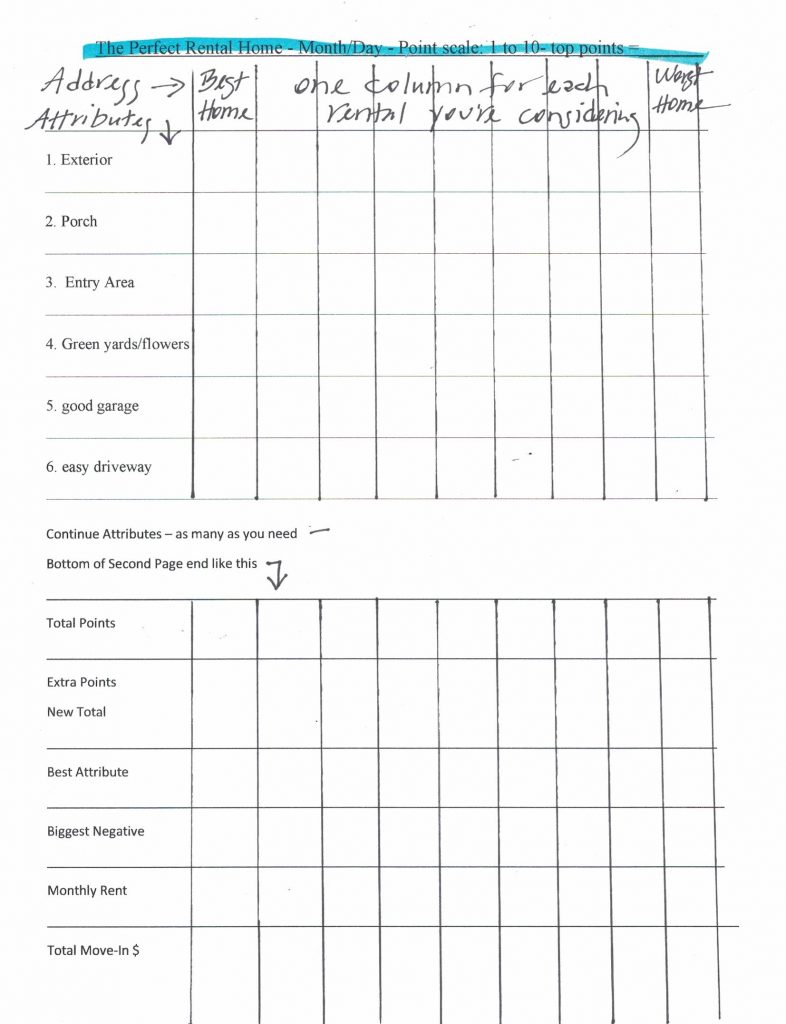
Your Perfect Rental Home List. Get out a big sheet of paper, or a notebook, and make a grid. Number down the left, each attribute you need. Be VERY specific. ‘Dark master bedroom, good guest room, bright office, den with fireplace, new appliances, large living room, separate tub, walk to shops and cafes, easy driveway, good garage, grassy lawn’, and so on. (My list never has anything about the kitchen because I don’t care much about them, but you certainly might. Walking to fun places is important to me, so it’s there.) Most of my lists have 40 categories (graph on last page). At the end is the ‘extra points’ space, where I write in any exceptional amenities – one has a fountain, another a view, special landscaping, garage storage – whatever it is – or maybe no extras. There is the box for ‘biggest negative’, like, uphill driveway. At the end, put the monthly rent.
Yes, money last, not first. This is the biggest mistake renters make, choosing first by price. Stay with me here and you’ll see why. Across the top, in the first space, put the address of whatever favorite dwelling you’ve ever had. Maybe where you grew up, or a room you rented in a great house during college, or for me – the first home I owned and never should have sold, and cried over for a decade. A decade. The list of bad choices that have ensued from that selling put me back in the renter category for 30 years. So, the best favorite place you’ve ever lived – if lucky enough to have had one – becomes your baseline, and probably informs the list of attributes down the left side.
NOW, add the point system. 1 is the lowest, 10 is the best. Think clearly about that perfect-base-line home you had, write the point number by the attribute, under that address. Maybe it had a wonderful den and that gets a 10. But really, not a great lawn so that gets a 5. Difficult driveway, for me, gets a 1. Sum total at the bottom. Reflection takes time, so dwell in that home you are ‘pointing’. Be fair in your remembering. On the far right I list/point the worst place I ever lived. Trying to weigh a home better or worse won’t help; tabulate correctly and you will have surprises, I promise.
Quick story before you begin. I was in a tiny, darling Craftsman house in Pasadena, desperate for a photo office/studio where clients could come, see my work, bring their wardrobe, change, and I could accomplish their photo-session all in one, as I used to. An amazing turret-apartment in the famous Castle Green had just become available, and I went to tour, application in hand. It would be $1,000 more a month than the cottage, but I’d be the photographer-in-residence in a glorious live-work space! THEN I DID THE LIST. WHAT? Turret and all, it only came it at ONE point higher than the cottage. A thousand dollars for one point? Heck no! I stayed in the good Craftsman and rented a retail space for my work. Without The List I’d have been miserable with the two-block walk from car to Castle, despite perks. Without The List I’d have never leased in the retail core, which was a great decision, and less expensive overall. Points first. Money last.
Totals. Best to do each home, one at a time, so as to remember well. For a 40-category list, that means the highest score any home could get is 400, higher if you put things in the ‘extra points’ box. It might surprise you that your baseline home does not come out perfectly! But this point-list shows you what really works for you in your daily living. Lastly, for each possible rental you then tour, get back in your car and do the list, on the spot. If it comes out a really high number, you may want to go right back in and pitch your case to be the chosen renter – a real skill in today’s hot market.
The art-of-the-renter-pitch. From 2010-2018, on the West Coast San Diego to Seattle, the package one had to give a landlord consisted of the application, your credit report, explanation of your income, a list of your activities (charitable, civic), list of personal and professional references, list with photos and vet letter about your pets, AND a personal essay on why you wanted that home. Not kidding. It was exhausting. I often ‘won’ the house – without a great credit score but absolutely no debt – by simply being a mature-single-female, which was a desirable category. 2018-2020 it came down to if you could cover the ridiculously high move-in cost = three months’ rent up front plus pet deposit. On the West Coast that meant handing over $12,000 to $18,000, and 30 days later another rent would be due. To move-in securely, pay for the movers, and have 2-3 months in the bank whilst one continued to work for income, in a 30-day period you had to have up to $34,000 cash on hand.
Most renters didn’t. They’d somehow saved enough by living in crummy apartments so came up with a down payment, well deserved. My work was always at home, save for the one Pasadena blip, with photo clients coming there, Sign Language students coming there. Had to be nice, to match my lovely furniture and a lifestyle curated when I too was a home owner. When my short marriage ended at age 39, stranded and having sold my second home to support us, I became a permanent-high-end-renter, the down payment further from reach as home prices no longer followed a natural soft climb.
Now, 2021-2022, thousands of former home-owners prefer to be a renter, so the game is different. A landlord will say they want a quality tenant in their home, but in fact it goes to whomever has the most money in the bank. This is new. And exclusive. It’s why most of us have lost at musical chairs recently, with foreign home-buyers taking what used to be rentals and leaving them empty as the goal is to show off their wealth rather than live there and add to a community. Just not enough homes left. I’ve had former landlords ready to give me high marks, but the call to references was never made. As a free-lance entrepreneur, I’ve always had to explain my variable income.
The one trick I can recommend today is be first in line. Haunt the rental sites. The second you see a viable home, CALL the landlord. Friendly voice, pitch why you love their house and why you’d be the best tenant. Be the first to tour, win them over. The number of first-day contacts they’ll receive will overwhelm; they may just shut it down if you can convince them. Currently I see First Responders being chosen (understandably), those without pets (makes me cringe however as pets are family), clean-looking families (ripped jeans may be your thing but look cheap), a need for a particular school, young couples with solid jobs and baby on the way. An owner is looking for a reason to make a selection. And then that bottom financial line, which means we can compete, or we just can’t, and an apartment is the only option, single-family dwelling a thing of the past, as – very honestly – it became for me a year into the pandemic. Good luck! We need it.